
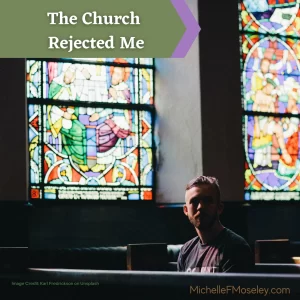
The title of this post came from a statement made by someone in a recent conversation about spiritual abuse and religious trauma. The concept of being rejected by the church struck a chord with me, and the individual who made the statement (not a client) gave me permission to share it and explore it more here.
I spent many years heavily involved in Christian circles, mostly evangelical Christian circles. I’ve heard the discussion that’s often had about folks who leave those circles. I’ve heard/read about the recent sermons and talks given regarding the “fad” of deconstruction. I’ve walked my own path of questioning beliefs and systems, acknowledging abuses of power where I was both a victim and a perpetrator, and of being the topic of conversation when I chose to assert more helpful boundaries for myself.
I’ve also had the privilege to support many folks on their own journeys of reconciling beliefs and experiences, of losing relationships with people they considered family, of feeling judgement and criticism and rejection from people who claim to align with a belief system based on a man whose life stories are filled with acceptance, inclusion, and welcoming for those outside the religious elite.
Who Does the Church Reject?
Rejection from the church is often felt by those who don’t fit into the prescribed “box” of the belief system, those whose lives haven’t followed the “promised” trajectory. Sometimes this rejection comes in direct forms such as churches that openly refuse to acknowledge the humanity of LGBTQ+ folks. Sometimes it’s more subtle, but often still based on rigid rules around gender norms and expectations.
I’ve been in church/ministry settings where no men were allowed to assist in childcare and no women were allowed to teach or speak. These rules had nothing to do with the talents and/or interests of the actual person, but were all about what was deemed “appropriate” for that binary gender. As a woman who has a gift for teaching (even based on the church’s own assessments of spiritual gifts) and is passionate about sharing information with others, I have been denied multiple opportunities to utilize those talents due to my gender. I’ve also been in church settings where there was a major need for more adults to assist with childcare; however, men were not even considered for the role solely based on their gender.
Another big focus for many churches is marriage and family. Ifyou have spent any time in church, you have likely heard at least one sermon series focusing on the importance of marriage, and possibly including a brief excerpt about how the single folks can prepare themselves for when they get married. These topics are spoken of as though everyone desires marriage and children, and everyone will follow a path that leads to marriage and children. What about those who don’t desire marriage? Those who do desire marriage with their entire being, but for whom that isn’t in the cards for their life trajectory? What about the folks who long to be parents, but are struggling to see that dream become reality? Or the folks who are childless by choice? When everything in a church/ministry is geared toward the idea that everyone is either married with children or waiting to be married with children, where do the thousands (millions?) of folks go for whom this is not reality?
How Does the Church Reject?
You may be finding that you resonate with the idea of being rejected by the Church. On the other hand, you may feel very welcomed in a church community and confused as to how someone could feel rejected. Here are just a few examples of how the Church can reject folks who don’t fit into the prescribed box.
Feelings of rejection, or not being fully welcomed, often surface around the gender norms that are present in the Church. There may be women’s events that are focused on wearing pink, baking, and learning to be a good wife. What if you don’t like pink or aren’t interested in baking? And, speaking from my own experience, when you’re in your late 30s and no marriage in sight, the constant focus on being a wife can leave you weary and questioning, ‘Why does it seem that a woman’s identity and purpose is so tied to her relationship to a man?’
The topic of motherhood is another area where many women feel rejected. I know several women who purposely do not attend services on Mother’s Day because of all the emphasis on being a biological mother. This overlooks those who mother folks in other ways, those who are struggling in their efforts to become a mother, those who have tension-filled relationships with their own mothers, and all the others who don’t fit within the narrow mold of biological motherhood celebrated in many churches on this day.
I’ve also seen men’s events that were focused on learning to hunt and eating absurd amounts of meat. This can communicate that you’re not truly a “man”, whatever that means, if you don’t enjoy hunting or if you prefer a vegetarian diet.
Another area of gender-based rejection is based on what some call “the Billy Graham rule.” Apparently, the famous evangelist Billy Graham had a rule that he would never be alone with a woman who was not his wife, not even to allow for a private conversation to provide spiritual guidance. I can respect honoring one’s marriage and ensuring that your spouse knows that your relationship with them is different than every other relationship you have. However, this “rule” plays out in extremely hurtful ways that exclude women from having a voice in many settings and indicate that men have no control over themselves sexually. I think most people outside the evangelical Church would agree that there is a monumental difference between sharing a hotel room with someone of the opposite sex (assuming that’s who you’re attracted to) on a multi-day trip versus having a conversation with an opposite sex co-worker to collaborate on a work-realted project. Additionally, the structure of the evangelical Church and its views on a gender hierarchy, are one of the few environments where grown adults can just choose not to interact with others in their workspace based on gender.
This gender hierarchy also creates a breeding ground for sexual abuse. I want to be clear that a churchmember/congregant does not have an affair with their pastor; the pastor sexually abuses that churchmember. There is a power dynamic at play there and abuse is all about power. When this continues to happen, and the men who are known to be perpetrators are protected and remain in positions of power, folks see that the Church is not a safe place. The lack of retribution for the abusers or support for the survivors is another way that many folks feel rejected by the church.
How Can the Church Do Better?
I truly believe that when we know better, we have the opportunity to do better. You may be in a position to help a particular church do better. Here are some ideas of how the Church (and individual churches) can do better, and perhaps decrease the number of folks who feel rejected by the Church.
Make room for all at the table. When one person (in evangelical Christianity, this is often a man who married young and has 2-4 young children) makes the decisions and guides the course of a church, many folks are left out. Many life experiences are overlooked, and the offerings of the church are only inviting for a particular segment of the population. I have seen some instances where one Black person or one woman was at least invited into the room for discussions, but it often seems more like tokenism – a “Hey, look at how accepting we are! We let someone else into the room.”
When I encourage making room for all at the table, I don’t mean hand-selecting one particular person to represent an entire group. I mean being open to all sorts of people with all sorts of lived experiences and intersecting identities actually being part of the conversation. I mean actually leaving room for folks to share their experiences and understandings and viewpoints without dismissing their perspective or interrupting them. I mean being willing to listen and learn and acknowledge that your way of being in the world is not the only way of being in the world. To acknowledge that the experience of a 40-something, single woman coming into your church is vastly different than that of a 20-something, married, father of 2 young children coming into your church – and that both deserve to feel welcome.
Get rid of the program and performance. Be human and messy and real. Don’t talk about “community” and “doing life together” and pointing people toward organized times to gather. You can actually be a community. If I don’t have a working A/C in the middle of summer because I need some help from someone with a shop vac, it does me no good to be invited to the local small group. Show up with a shop vac and help me with my actual problem. Don’t spend so much time planning and paying for the greatest show and the newest technology that you leave no room to live life in a way that reflects what you proclaim to believe. Recall that Gandhi said, “I like your Christ, I do not like your Christians. Your Christians are so unlike your Christ.”
Acknowledge abuse within the Church. There is far too much evidence at this point to ignore that sexual abuse happens within the Church. Spiritual abuse also occurs at alarming rates within the Church and parachurch structures. Unchecked power in any situation is fertile ground for abuse to occur. Rather than arguing about it, discounting the narratives of survivors, sweeping it under the rug, or putting so much time/energy/money toward protecting abusers, the Church could aknowledge the pain caused by abuse and the ongoing repercussions for survivors. Be willing to take ownership of the fact that aspects of gender hierarchy and power within Church leadership created an environment to allow abuse to occur. Seek input from trauma-informed, licensed mental health providers to gain understanding of the effects of abuse and options for course correction. Be open to changing the course, even when it’s not comfortable.
If you are someone in a position of leadership with a church or other faith-based organization, I invite you to consider a workshop such as my Mental Health for Faith Leaders as one way of being part of decreasing harm and rejection in the church.
Healing for Those Who Feel Rejected
Feeling rejected by the Church often comes with loss of relationships and feelings of shame for not being able to fit into the prescribed box, for not somehow figuring out how to have the life you were told would come. It can be hard to trust anyone. You can feel adrift in the world and untethered from beliefs and rhythms that were central to your life. You may be riding a wave of bitterness and anger, dwelling in a place of sadness and loss, or feeling exhausted trying to maintain a spiritual practice.
I encourage you to seek support. That may look like finding an online community dedicated to supporting those who are questioning or have been harmed. That may mean finding an individual therapist and/or support group – Reclamation Collective is a good source for both. That may mean spending more time connecting with nature or music or body movement.
If you’re in NC, and these concepts resonate with you – whether you feel rejected by the church or you’re in church leadership and want to do better – feel free to contact me. As a licensed mental health professional, a survivor of spiritual abuse, and someone who specializing in working with relgious/spiritual harm, I understand the tenderness of navigating these experiences. I work with lots of folks for whom adverse religious experiences are part of their story, and strive to support my clients with finding the best path for them, which may or may not include continued spiritual involvement. I’m happy to chat with you and see and see if I am the right person to provide support to you – contact me here.
Michelle F. Moseley (she/her) is a Licensed Clinical Mental Health Counselor in NC. She believes ALL people deserve respect, compassion, and access to mental and physical healthcare. Michelle specializes in working with survivors of religious trauma, and with those who have body image concerns, finding there is frequent overlap in these areas. She also frequently supports late-identified neurodivergent individuals as they navigate the grief and relief of a new understanding of self. You can learn more about Michelle by visiting her website at MichelleFMoseley.com or following her on Instagram – @therapy_with_michelle
Sign-up for Michelle’s Monthly Email Newsletter to make sure you never miss a blog post