
Shiny, Happy People. This is the name of a documentary series that just released its 2nd season. This is also the description of the appearance that many churches and religious organizations direct their members to display. The goal is often the appearance of happy people who are “shining the light of Jesus into the world.”
This focus on how things appear can leave a trail of hurting, wounded, traumatized people in its path. Both seasons of Shiny, Happy People document just that.
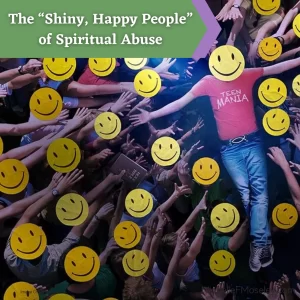
The first season of Shiny, Happy People focused on the teachings of Bill Gothard, the Institute of Basic Life Principles, and the Duggar Family. I found that one difficult to watch, and it also didn’t reflect much of my personal experience. This second season focuses on Teen Mania, Acquire the Fire, and the other programs of Ron Luce. I had to take intentional breaks between episodes (and sometimes during) this one because the themes so closely resembled some of my own experiences in evangelical ministry spaces.
This post highlights a few of the things I noticed as a watched season 2 of Shiny, Happy People.
The Role of Influencers
The term “influencer” had a very different meaning in my young adult years in the pre-social media era. Yet, if you asked pretty much anyone who was part of evangelical circles in the late 1990s or early 2000s if Joshua Harris influenced them, the answer would be “yes!”
Joshua Harris wrote the book I Kissed Dating Goodbye, which was the cornerstone for many evangelical teens and young adults of that time period in understanding relationships. The message? Dating = lots of activities with lots of different people = bad. Courting = intentional (often chaperoned or group) time with one person you were considering marrying = good. Physical affection before marriage = bad. Many folks even took this so far as to commit to not holding hands with someone before engagement or marriage, or not kissing prior to the wedding. There was also quite a bit of shame associated with not making / keeping those commitments.
This book was a big part of the purity culture movement that has impacted so many folks who were part of evangelical Christianity during the 90s/00s. I was introduced to it my sophomore year in college when we did a small group study on the contents. It left me feeling a sense of shame because I had previously held hands with and kissed someone. It also began creating a rigid and unhealthy view of how relationships should work that followed me through almost 2 more decades of singleness.
Joshua Harris shows up in season 2 of Shiny, Happy People, and I am not alone among those who survived the impacts of his book in asking, “What the hell is he doing here?” To my understanding, Joshua has acknowledged the painful impacts of his books and speaking gigs. However, a consequence of his previous influence is that his presence is still dysregulating for many. It still has influence for me despite decades of deconstructing those teachings.
The Most Committed are Often the Most Harmed
I have often said that those who think deconstruction or leaving a faith community is easy have never had a real conversation with someone who is going through that process. Season 2 of Shiny, Happy People shows multiple examples of the ways that those who were the most committed were also the most harmed.
There are likely thousands of adults who attended a Teen Mania or Acquire the Fire event as a teen and it’s just a blimp on their timeline of life experiences. Yet, there are (at least) 100s more who have been forever impacted by their experiences within these groups.
These are the folks who took the commitments made during those events very seriously – commitments to follow God to the ends of the earth, to give up time with family or pursuits of education outside the organization. These are folks who lived and breathed these beliefs, totally committed to following God in the ways they were being told were best.
These are also the folks who are now carrying the impacts of that commitment in their adult lives in ways they could’ve never imagined. Some of these individuals were placed in physical harm in the name of being “trained up for God”, continuing to carry the literal scars of those experiences in their bodies. Others have talked about the ways they have struggled to find friendships or community. Their ability to trust others has been marred in ways that may affect them for the rest of their lives.
The nervous systems of all of us who have experienced spiritual abuse and who resonate with the term religious trauma are forever impacted by these abuses of power. Yes, there are many effective ways to help heal from the PTSD-esque symptoms and there are helpful ways to allow our nervous systems to find safety. Yet, even though there can be healing, the nervous system of many survivors of religious harm still carries the scars.
This is part of why many survivors who have watched this 2nd season of Shiny, Happy People were impacted by seeing Joshua Harris appear on their screens, or why many of us needed to take intentional breaks amidst watching the episodes. This is why I found myself sighing deeply at various portions of the documentary as a way of regulating my nervous system, or commenting aloud at other points as a way of releasing the dysregulation. Survivors carry the scars of the harm.
The Same Person May Be Both Victim and Abuser
Many of these high-control systems create a dynamic where many individuals find themselves in the role of both victim and abuser. That was true in my experience and it’s also highlighted in the stories of some of the Teen Mania Alumni featured in Shiny, Happy People.
Some of the alumni talk about their commitment to various programs within the Teen Mania organization. They share the ways they were controlled – lack of sleep, rigorous work schedules, forced into dangerous “missions”, etc. They talk about some of the ways these things affected them at the time and continue to impact them today. And they also share some of the ways they became enforcers of the control with others who were part of the organization – demanding the work when put in places of leadership, reporting others for behavior violations. For many, both the role of victim and abuser were a part of these programs they were paying large financial costs to be a part of (another form of control and abuse).
This dynamic is what happens when a group is focused on controlling behavior and appearance, and uses spiritual concepts to avoid dealing with emotions or relational wounds. The latter is what is known as spiritual bypassing – this focus on using spiritually-loaded language or concepts to avoid aspects of being human lays a foundation for control and abuse.
For some survivors of religious harm, coming to terms with the ways you were harmed and the ways that you may have harmed others can be the most difficult part of healing. This may involve painful acknowledgement of your roles, grieving your actions / impact, and possibly attempts to reconcile or repair the harm done.
The Connection to Christian Nationalism
There has been lots of discussion about the ways that politics and religion have become intertwined in the US. This has been a decades-long process, and the history is beyond the scope of this blog post. However, this latest season of Shiny, Happy People sheds some light on some of the things that have contributed to this current point in history.
What is Christian Nationalism? One way to define it is as an “ideology rooted in the idea that the United States was founded as a Christian nation and that US laws should reflect [certain] Christian values.”
Those of us who grew up in evangelical culture from the 90s onward have likely heard multiple versions of “we’re in a culture war” or “Christians have to stand up to the evil of the world / government.” Shiny, Happy People highlights some of the ways that Ron Luce and Teen Mania promoted this message, even to the point of creating a program called “Battlecry” and utilizing military motifs to enhance their message.
Those of us who were teens in the 90s and early 00s were surrounded by messages about the evil in our music and the importance of being ready to fight (and even die) for a particular version of Christianity. This messaging during our formative years uniquely primed us to be involved in the current “culture wars.” For some, that has included an increased focus on attempts to ensure particular versions of Christian teaching are embodied in governmental decisions. For others, it has meant an increased awareness of the impacts of these forcible and militarized attempts to combine church and state. We aren’t confused about how we got here as a country, but we know the path leaves a lot of pain in its wake.
What’s Next?
I don’t know if there will be future seasons of Shiny, Happy People. I do know that there are plenty of stories of power being misused by spiritual leaders and of the harm experienced in high-control settings. Though the outward appearance may be that of joyful people for a while, survivors often fight for years to become their own version of an actually shiny, happy person living a life that works for them.
If you have experienced harm in a spiritual or religious context or are someone looking to learn more about this topic, here are a few options for next steps:
- Therapy (in NC) – I provide both individual and group therapy to adults in NC, specializing in supporting those who have experienced religious harm. You can learn more about Religious Trauma Counseling or Religious Trauma Groups via my website.
- Continuing Education for Mental Health Professionals – As an approved provider for NBCC, I offer several continuing education opportunities throughout the year on topics related to religious harm, high-control dynamics, and other abuses of power. These can be a great way to expand your understanding of these experiences and increase your cultural competency in working with survivors.
- Informational Workshops – These workshops can be provided in-person or virtually and are a great way for folks to learn more about mental health, the impacts of high-control dynamics, the reality of religious harm, and ways to create a more trauma-sensitive environment. My workshop entitled “Mental Health for Faith Leaders” is designed specifically for those who lead in a religious context.
Michelle F. Moseley is a Licensed Clinical Mental Health Counselor in NC. She believes ALL people deserve respect, compassion, and access to mental and physical healthcare. Michelle specializes in working with survivors of religious trauma, and with those who have body image concerns, finding there is frequent overlap in these areas. She also frequently supports late-identified neurodivergent individuals as they navigate the grief and relief of a new understanding of self. You can learn more about Michelle by visiting her website at MichelleFMoseley.com or following her on Instagram – @therapy_with_michelle
Sign-up for Michelle’s Monthly Email Newsletter to make sure you never miss a blog post