

How should licensed therapists utilize social media? Is it a great way to share information and allow potential clients to get a feel for who you are? Is it a trap waiting to happen when you share a bit too much? Is it a necessary part of a modern marketing strategy?
These are all questions that therapists are asking on a regular basis in the modern landscape of therapy, social media, and online presence.
I’m Michelle F. Moseley, LCMHC, a licensed mental health counselor in North Carolina who specializes in providing trauma-responsive and neuro-affirming care. I entered the world of social media back in the early 2000s with MySpace – Tom was my first friend (if you know, you know). I was an early-ish adopter of Facebook because I had access to an alumni email with a .edu domain despite being a couple years out of college. I was a little slower to adopt Instagram and have chosen not to use TikTok, although I do enjoy the occasional Threads activity.
Although there are certainly folks in the mental health space who have larger followings than I do or who post far more frequently, I am writing on the topic of social media use as a licensed therapist because it has been an intentional part of my marketing since early in my private practice. I made the choice to create professional social media pages on specific platforms, reviewed ethics around digital presence, and have been intentional with decisions related to social media use along the way.
In this post, part 1 of a 2-part series, I’m going to share a bit about what has gone into my decisions related to social media as a licensed mental health therapist, as well as some things you may want to consider if you’re contemplating if/how to use social media as a licensed therapist (or other support professional).
Guidelines from Ethical Codes
Technology is constantly changing and it’s hard for the ethical codes to keep up sometimes. However, both the American Counseling Association (ACA) and the National Association of Social Workers (NASW) agree on some general guidelines in the use of social media by licensed professionals.
Some of the common guidance from both organizations includes:
- Keep private social media accounts and professional social media accounts separate.
- Stay within your scope of practice in posts on professional social media accounts.
- Consider the risk of friending, following, or exchanging messages with clients (or potential clients) via social media.
- Maintain confidentiality – do not post about clients or share private information (even in closed groups).
- Avoid checking a client’s social media accounts, even if they are public, without client permission. (I would encourage only looking at their social media if they request you to do so and you do it together during a session.)
- Develop a thorough social media policy and share this with clients as part of your informed consent documents at the beginning of services.
Now that we know what the ethical codes have to say in regards to social media, let’s take a look at some other considerations.
Which Platforms?
Your answer to the question of which social media platforms, if any, to utilize as a mental health professional depends on a few things.
Where does your ideal audience spend time?
Think about who you are hoping to reach with your content. Are you looking to share information with adolescents? Is your goal to connect with 30-something women who are looking for resources and support? Do you provide therapy for women in their 60s who are reevaluating their life? Is your content geared toward other mental health professionals? These questions will help you answer the question of which platforms to utilize. The place where your ideal audience is already spending time is a good place to focus your social media energies.
What is your style?
What kind of things do you want to post? If you enjoy making short videos, then Tik Tok might be your ideal space. Do you like a variety of photos, videos, and multi-photo posts (also known as carousels)? That sounds like Instagram could be a good place for you. Looking to write more long-form content geared toward other professionals? That might make LinkedIn or Substack the platform that best fits your style. Consider what type of content is allowed and does well on the various platforms. Then, think about how that connects to the types of content that you actually enjoy creating and sharing to find your social media sweet spot.
What is your comfort level with various social media platforms?
How comfortable are you with a specific platform? And, if you’re not familiar with one, do you have the time, mental bandwidth, and desire to learn something new? The answer to this one can help narrow down your options.
Here’s a bit about how these questions played into my decisions to have a professional presence on Facebook and Instagram.
- My ideal audience is millennial and Gen X women, both in general and other mental health professionals. These folks are likely to be on Facebook and Instagram (depending on their age), with some on Tik Tok.
- My style for both the content I prefer to consume and to create leans toward carousels and brief educational videos. I am not someone who is willing or able to follow the latest trends (in life or on social media) and I have no interest in creating dancing videos. These preferences made Facebook and Instagram a good fit, with the occasional post on LinkedIn. Threads came into the mix later as a space to share written thoughts in short-form.
- At the time I decided to create professional social media profiles, I was familiar and comfortable with Facebook and Instagram. Although, they are continually changing and that can be a new learning curve at times. I was not feeling a desire to add another platform to my knowledge base, and chose to stay off Tik Tok both personally and professionally.
These are not decisions that demonstrate the “right” or only way to engage with social media as a licensed mental health therapist. These questions help you think through your why for creating professional social media pages and move you forward with deciding on the where.
Being Clear About Who You Are
Transparency and trustworthiness are two of the core principles of trauma-informed care as outlined by the Substance Abuse and Mental Health Administration (SAMHSA). These are principles that are important to all aspects of our role as mental health professionals, including how we present ourselves on professional social media accounts.
What might this look like in real life?
- Including your real name in your professional profiles. I realize that the idea of listing your real name on your profile can come with some concerns, particularly for women or other marginalized groups. It’s also important to balance those concerns with the fact that professional social media is generally designed to drive folks to your website, where we’re actually required (in most US states) to list our full name and licensure to provide clarity to those interested in our services. Having your full name listed also allows folks to find your account if they only know your name and not your link or handle.
- Clearly listing your credentials and licensure status. Some US states are beginning to pass legislation that licensed professionals must include their licensing information on professional social media profiles. This allows those viewing your content to easily verify your education and other credentials to be speaking about a specific topic. It’s also important to be transparent about whether you are independently licensed, practicing under supervision, or a therapist-in-training. This transparency builds trustworthiness around your content and you as a mental health professional.
Next Steps
Are you feeling a bit more clear about if or how you want to utilize social media as a licensed mental health therapist? It’s possible you have decided that social media is not for you – and that is totally fine. Just as we can’t be the right therapist for every person, not every avenue of marketing is going to work for you.
Perhaps you’re feeling a bit less overwhelmed by the prospect of getting started (or actually posting something on that page you started a while ago). Head over to Part 2 of this series where I’ll share more about things like accessibility, social media disclosures, and ethical considerations related to the use of social media as a licensed mental health therapist.
If you want to talk one-on-one about your social media use and how to navigate making these important decisions, I’d love to schedule a Professional Consultation session with you. Unlike those programs where someone is promising immediate growth in followers or that your content will go viral, I’m not going to make promises about things I can’t control. What I can offer is a space for you to ask your questions about social media use and receive support grounded in research, conversations, personal experience, and review of related ethical codes. You will walk away feeling more confident in your decisions about social media usage as a therapist, no matter what those decisions might be.
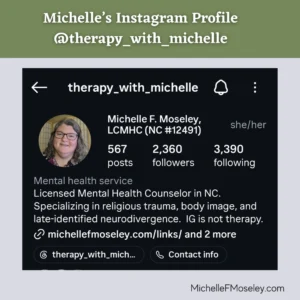
Michelle F. Moseley (she/her) is a Licensed Clinical Mental Health Counselor in NC (#12491). She believes ALL people deserve respect, compassion, and access to mental and physical healthcare. Michelle specializes in working with survivors of religious trauma, and with those who have body image concerns, finding there is frequent overlap in these areas. She also frequently supports late-identified neurodivergent individuals as they navigate the grief and relief of a new understanding of self. You can learn more about Michelle by visiting her website at MichelleFMoseley.com or following her on Instagram – @therapy_with_michelle
Sign-up for Michelle’s Monthly Email Newsletter to make sure you never miss a blog post