
Welcome to Part 2 of this 2-part blog series on the use of social media as a licensed mental health therapist. If you haven’t read Part 1, head over and do that here. We’ll be right here waiting when you get back.
Now that you know more about who I am – Michelle F. Moseley, LCMHC, a licensed mental health counselor in North Carolina who has done some deep dives into logistical, practical, and ethical aspects of having professional social media accounts – let’s recap where we’ve been. In Part 1, we took a brief look at some ethical codes from ACA and NASW. We also explored some questions to help you determine if and where to have a professional social media presence. Finally, we considered the importance of providing clarity about your education, credentials, and knowledge related to the content you post.
In this post, we’re going to look a little closer at accessibility factors, ethical considerations, and the importance of a social media disclosure. So, let’s dive in…
Accessibility
Accessibility can apply to several aspects of your social media presence as a mental health professional. The following are a few areas that are important to consider:
Emoji Use and Placement. It is common for individuals to include emojis in their social media profiles and captions. The use of emojis has only risen as more folks are utilizing AI to write captions (for whatever reason, AI likes those emojis). These can look nice and add some visual appeal for some visitors to your social media profile. However, the use of emojis can cause issues for those who utilize screen readers in order to access social media. Many emojis have specific descriptive text that is associated with them. So, while a sighted visitor to your profile may see a cute icon before some text, a visually impaired visitor may be confused by what the text means.
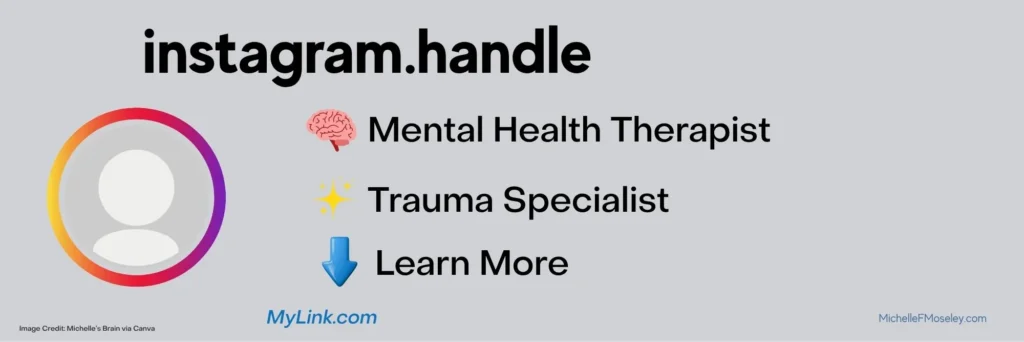
For example, the image above is a simplified example of an Instagram bio. The top line is the person’s “handle” (i.e. their user name on the platform). There is a circle with an image to the left of the profile – this is where you might choose to place a picture of you or your practice logo. At the bottom, is where you can put important links to websites or resources that you want people to visit. The middle section is where many people will utilize emojis as part of their description of who they are or what they do. This makes sense to a sighted user who is viewing the content visually.
However, for someone using a screen reader, their experience may be very different. They visit your profile and might hear from their screen reader some version of, “Brain graphic mental health therapist sparkly star trauma specialist blue down arrow learn more.” What does that mean? What is a “sparkly star trauma specialist”? Considering how various social media users are going to be able to view and understand your profile is a part of accessibility, and of being a trauma-informed provider.
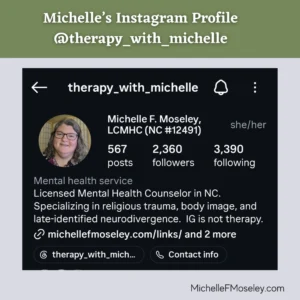
The image below is how I have chosen to describe myself in my Instagram bio. It may not be as visually colorful as others, but the information is clear and in a format that is accessible to a wide variety of social media users.
Use of Specialized Language. Every occupational field has its own phrases and abbreviations. In a previous role that I held, there was a specific training that was called “IBS” for short. Everyone in the organization knew what that meant, but using that abbreviation in other contexts would lead to a very different understanding!
Posting as a licensed therapist on social media can come with similar struggles. Think of all the abbreviations that are utilized in the therapy field – CBT, DBT, IFS, EMDR, ERP or LPC, LCSW, PsyD, LCMHC, LMHC, LPA. No wonder people are confused when trying to find a therapist or figure out what kind of therapy might be helpful for their concerns!
It’s important to evaluate the language we use in social media content. As licensed mental health professionals, we want to balance both clinical accuracy with sharing in a way that feels approachable to the average viewer and our ideal audience. And we have to do this within the confines of whatever platform we’re choosing to post our content on.
Social Media Disclaimer
One way to offer clarity about who you are, what you do, and what people can expect from your social media content is to include a social media disclaimer as a pinned or saved post on your profile. The specifics of what this looks like or how to ensure it remains visible near the top of your profile will vary depending on the platform.
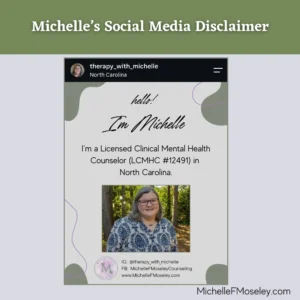
The image below is an example of what my social media disclaimer looks like. I divided the information amongst 12 images or slides and posted them as one post on both Instagram and Facebook. You can view the full disclaimer on Instagram here or visit my professional Facebook page and see the disclaimer as a “Featured” post near the top of my profile.
What are some things to include in a social media disclaimer?
- Name, licensure / credentials, and location
- Specialties & populations you work with
- Contact information for connecting off social media
- Limits and boundaries related to what you post and how you interact on social media
Ethical Considerations
Licensed mental health therapists have agreed to abide by a code of ethics, both in the therapy space and in the ways we present ourselves professionally both in person and online. We looked at some general guidance from ethical guidelines in Part 1 of this series. What are some things to consider related to the ethics of a professional social media presence?
The Weight of Your Words. Utilizing social media as a licensed mental health therapist means that what you share comes with a certain level of trust in your knowledge and in the accuracy of your content. A good rule of thumb when considering what to post is to ask yourself, “Would I share this information in another part of my professional role?” If the answer is “yes,” you’re likely good to go on the sharing (assuming confidentiality is kept in tact).
Client Confidentiality. Licensed therapists have both ethical codes and laws that protect the confidentiality of the folks we work with. The commitment to protect client confidentiality doesn’t disappear when we’re posting content online. One way to maintain confidentiality is to avoid interacting with clients on social media – no friending, no following, no checking their profiles or pages.
Another important part of client confidentiality in relation to social media is DO NOT POST ABOUT CLIENTS ONLINE! This does not only mean not saying things like, “I saw client Sally today at 4pm and she is really struggling with her new job.” It also means avoiding posts that start with things like, “I just got done with a session with a really tough client…” Regardless of whether you actually did just finish a session that was tough or not, a client could see when this was posted and assume it’s about them. Or a potential client could see it and determine they wouldn’t feel comfortable seeing you because it appears you talk about specific clients online.
There are many ways that we can share about our work or the common themes that are coming up with clients without talking about specific individuals (or appearing to do so).
Social Media Policy as Part of Informed Consent for Therapy. Informed consent is an important part of the therapeutic relationship. This includes not only the documents provided to clients at the beginning of therapy, but ongoing discussions about areas like communication and relational boundaries. If you are utilizing social media in a professional capacity, your informed consent needs to include a Social Media Policy.
Now, I’m not a lawyer and this is not legal advice, but a basic social media policy should include things like acknowledgement that you have professional social media accounts, expectations around how clients interact with those, and clarity about boundaries around how you interact with (or avoid interacting with) clients on social media. Therapists should always seek their own legal counsel in regards to the legal documents that are a part of ethical practice, including your social media policy.
Want More?
I hope this 2-part series on social media use as a licensed therapist has been helpful for you. It may have given you some clarity on whether you want to utilize social media in a professional capacity. Or you may have come across some new considerations as you update your own use of professional social media.
If you want to talk one-on-one about your social media use and how to navigate making these important decisions, I’d love to schedule a Professional Consultation session with you. I acknowledge that I don’t have a huge following on social media – my priority is to post for the right people to find me rather than for the most people to find me. I’m also not going to make promises about how fast you will grow your account or that I can tell you exactly what to post to go viral – those are things I can’t control with an ever-changing algorithm.
What can I offer? A supportive space for you to ask your questions about social media use as a licensed therapist. You will receive feedback and information that is grounded in research, conversations, personal experience, and review of related ethical codes. You can walk away feeling more confident in your decisions about social media usage as a therapist, no matter what those decisions might be. Learn more about Professional Consultation here.
Michelle F. Moseley (she/her) is a Licensed Clinical Mental Health Counselor in NC (#12491). She believes ALL people deserve respect, compassion, and access to mental and physical healthcare. Michelle specializes in working with survivors of religious trauma, and with those who have body image concerns, finding there is frequent overlap in these areas. She also frequently supports late-identified neurodivergent individuals as they navigate the grief and relief of a new understanding of self. You can learn more about Michelle by visiting her website at MichelleFMoseley.com or following her on Instagram – @therapy_with_michelle
Sign-up for Michelle’s Monthly Email Newsletter to make sure you never miss a blog post